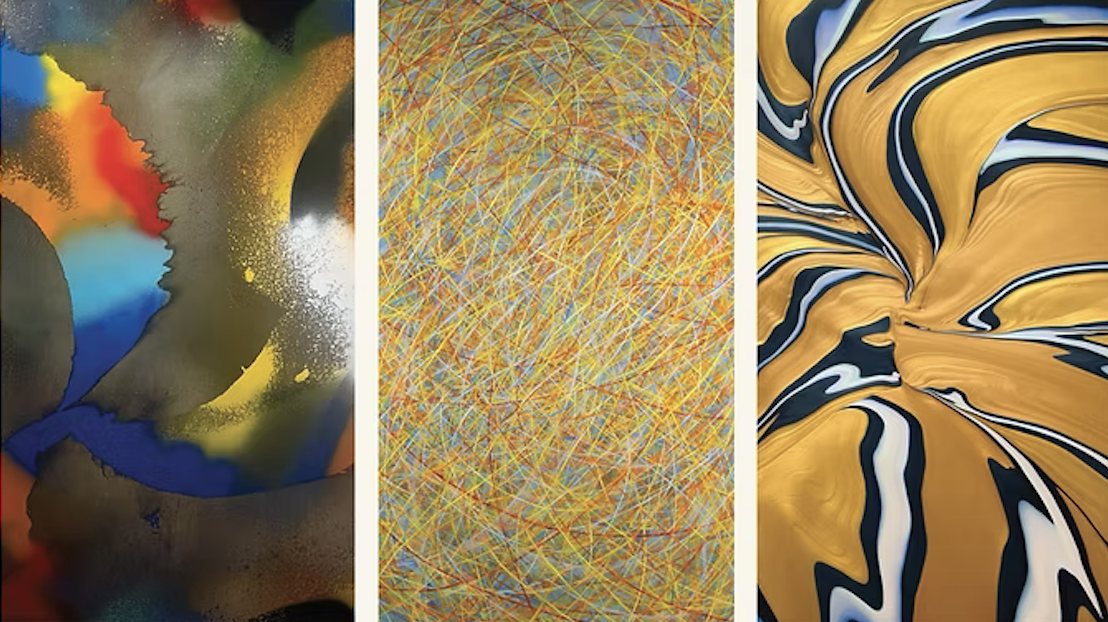
from left to right, detail: gleason, guffogg, moses - courtesy of gallery chang ny
LIVING WITH ABSTRACTION: GUFFOGG, MOSES, AND GLEASON
WRITTEN BY VICTORIA CHAPMAN
There is a particular experience that occurs when living with abstract painting over time. Unlike representational compositions — images that belong to a familiar visual language and can be immediately understood through recognition — abstraction unfolds slowly. Its presence is atmospheric rather than narrative, perceptual rather than descriptive. One does not simply “look at” an abstract painting; one lives alongside it, returning to it repeatedly and, in the process, experiencing a gradual journey inward through perception itself.
Over days, months, or years, the work begins to shift in relation to consciousness. Color changes according to light and mood. Surfaces expand and contract through prolonged attention. The painting no longer functions merely as an object on a wall, but as part of the psychological and spatial atmosphere of daily life.
Perhaps this is one of the enduring qualities of abstract painting: its ability to move beyond direct representation and enter a more contemplative realm of experience. Without recognizable imagery to anchor interpretation, the viewer encounters something less fixed and more internal — sensation, rhythm, memory, tension, movement, silence, and awareness itself.
In this way, abstraction does not ask to be completely understood. Instead, it asks the viewer to remain present within the act of seeing.
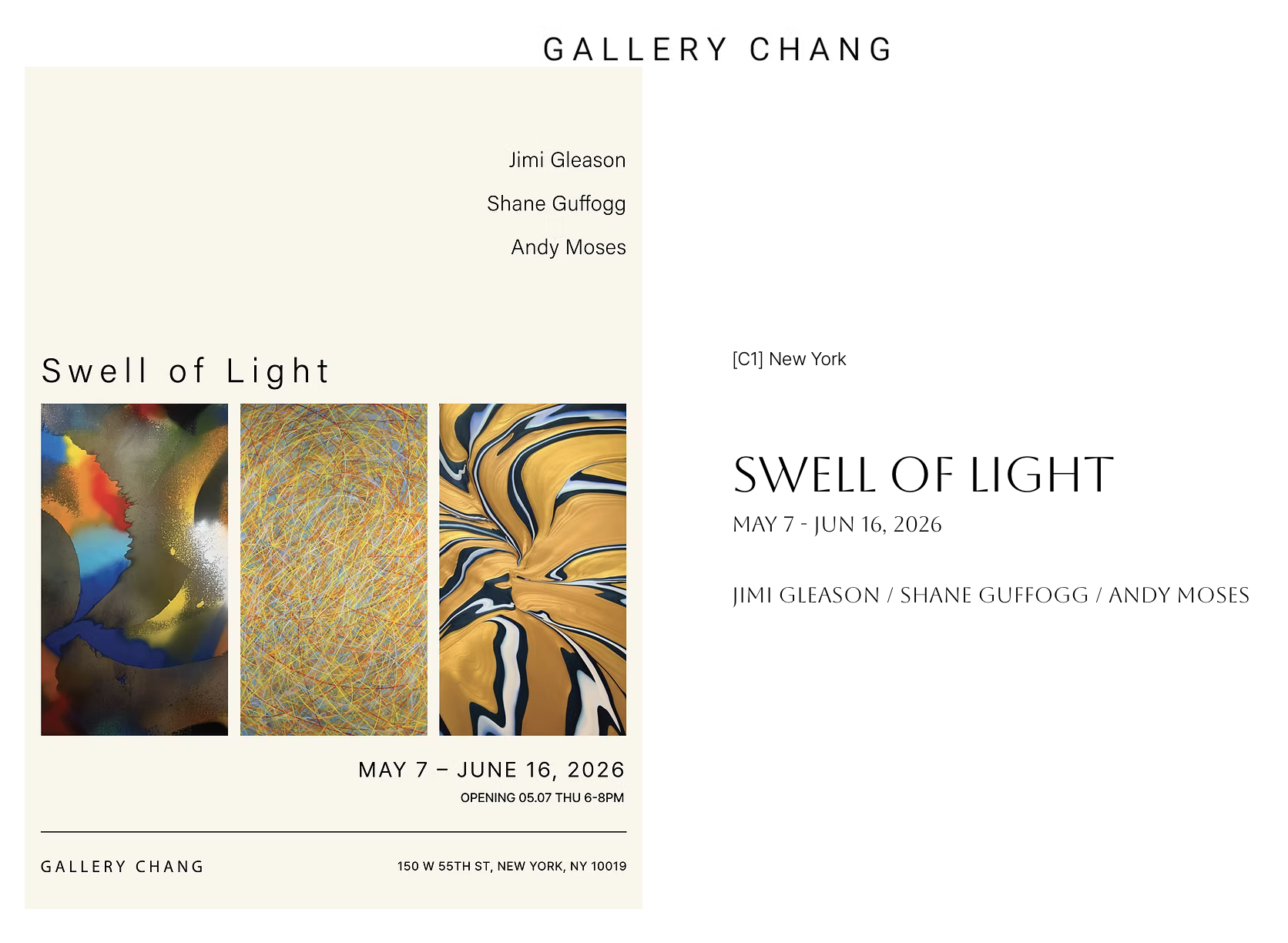
postcard for the exhibition Swell of light featuring shane guffogg, andy moses, and jimi gleason at gallery chang Ny - courtesy of gallery chang
Within the works of Shane Guffogg, Andy Moses, and Jimi Gleason, abstraction emerges through three radically different relationships to paint, process, and perception, yet each artist moves beyond representation toward a heightened state of visual and psychological experience.
Shane Guffogg approaches painting through intuition and sustained concentration. Working without preliminary sketches, he enters directly into the act of painting, often with a single brush and tube of paint. Through millions of accumulated hand-painted lines, his compositions expand into luminous atmospheric fields that hover between structure and dissolution. His process feels less imposed than negotiated — a continual balancing between order and chaos unfolding in real time.
The paintings carry an extraordinary sense of duration. Every mark records a moment of attention, repetition, and physical presence. From a distance, the works appear almost immaterial, vibrating with light and movement; up close, the surface reveals itself as an intricate architecture of countless individual gestures. Each brush stroke defines a moment. There is something deeply meditative within this accumulation. The paintings do not announce themselves loudly but instead reveal subtle shifts through prolonged observation. To live with Guffogg’s work is to experience a surface that never fully settles. The paintings seem to breathe, pulse, and evolve through perception itself.
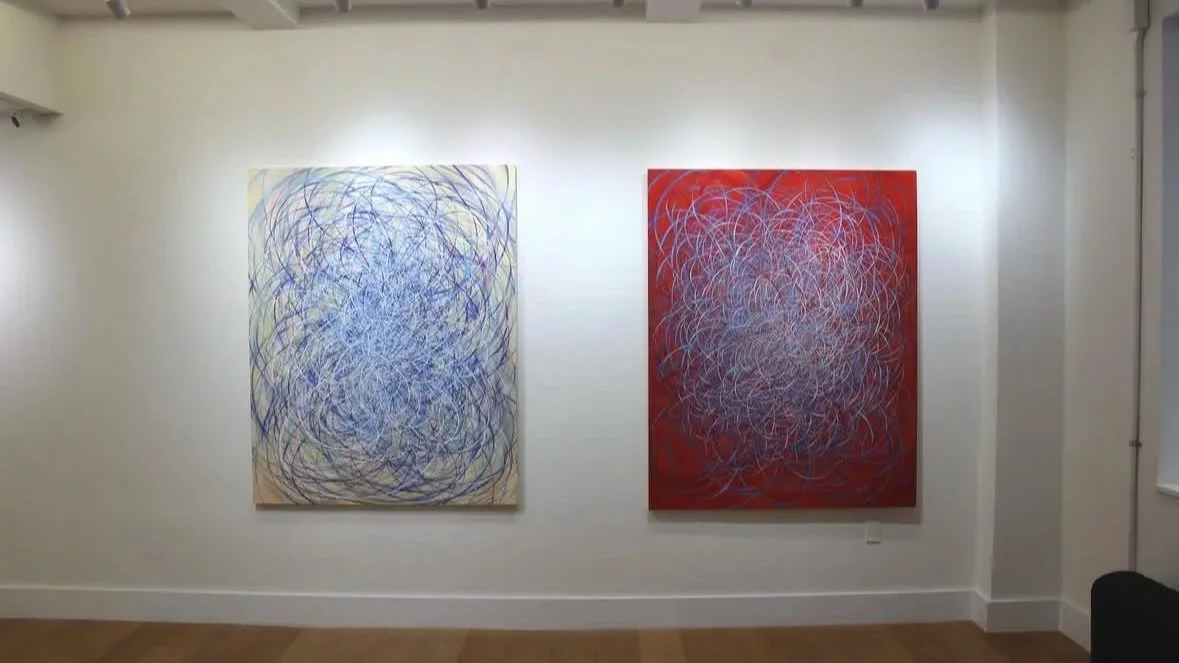
shane guffogg
Andy Moses arrives at abstraction through an entirely different process. Where Shane Guffogg builds complexity line by line, Andy Moses releases complexity through fluid movement and material behavior. His paintings emerge through gravity, viscosity, chemistry, and motion. Working on curved canvases, he pours and manipulates liquid paint across the surface, allowing physical forces to operate within the composition itself. The artist establishes conditions for emergence rather than complete control over outcome.
The paintings evoke atmosphere, geological formations, oceans, weather systems, and cosmic space, though never through direct depiction. Instead, they function as manifestations of transformation and instability. The paint appears to possess a life of its own, generating luminous transitions and optical depth that feel both natural and otherworldly. Moses transforms process into event. His surfaces retain the evidence of motion itself — paint suspended between accident and orchestration.
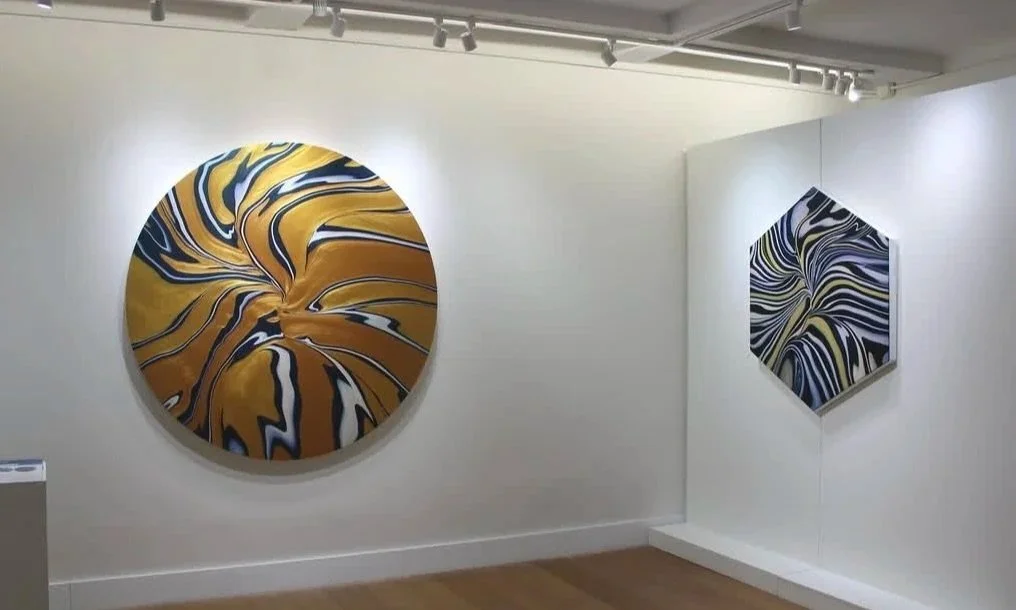
Andy moses
Jimi Gleason approaches abstraction through yet another perceptual language. His reflective, metallic, and glass-like surfaces destabilize the boundary between painting and illusion. Built through translucent layering, polished finishes, sprayed passages, and material experimentation, his works shift continually as light moves across their surfaces. The paintings often appear solid and immaterial — like liquid metal, mirrored atmospheres, or suspended fields of color.
Unlike the gestural intensity associated with earlier abstraction, Gleason’s work operates through restraint and optical calibration. The paintings ask the viewer to slow down and remain attentive to subtle perceptual changes. Reflection becomes unstable. Depth becomes uncertain. The surface oscillates between revealing and concealing itself. In this way, Gleason transforms painting into a phenomenological encounter where seeing itself becomes the subject.
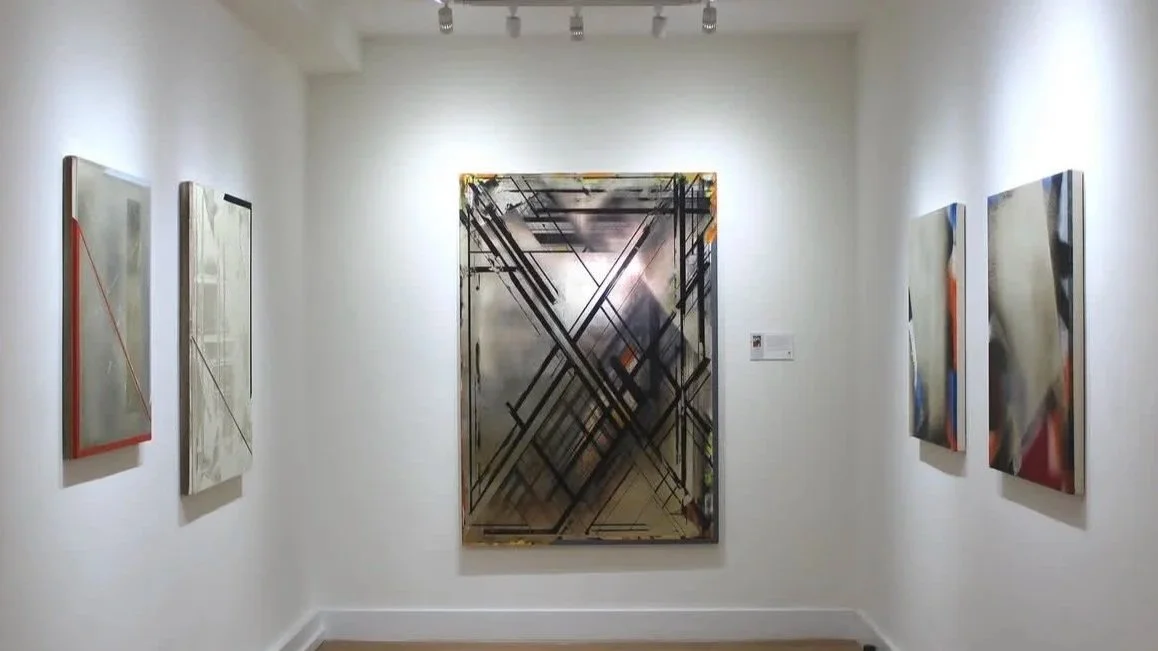
jimi gleason
Although these three artists work within different methodologies, they each expand abstraction into their own language. Their paintings are not concerned with depicting external reality, but with creating experiential states that activate consciousness through perception. Guffogg approaches paint as conduit — a rhythmic extension of intuitive awareness. Moses approaches paint as event — a fluid process and material transformation. Gleason approaches paint as perceptual surface — an encounter between light, reflection, and optical experience.
Together, their works reveal the continued relevance of abstraction not as an escape from reality, but as an expansion of it.
What abstraction ultimately offers is not the certainty of recognition, but the openness of experience. These paintings do not ask the viewer to understand them completely. Instead, they invite sustained attention, contemplation, and presence. They remind us that perception itself can become a form of inquiry — and that within the silent language of abstraction, there remains space for mystery, awareness, and the possibility of encountering something beyond words.
This is why living with abstract painting becomes such a personal and experiential act. The works allow the viewer to encounter shifting states of perception, mood, and awareness over time. The dialogue between painting and viewer evolves naturally, shifting from day to day as both the work and the individual change in relation to one another. Light changes. Mood changes. Attention changes. The painting reveals itself differently with each return.
As individuals moving through constantly changing emotional and psychological conditions, we can learn a great deal from living with abstraction. These paintings teach us to slow down, remain attentive, and become more aware of the act of perception itself. In their openness and ambiguity, they create space for reflection, introspection, and a deeper encounter with consciousness through the act of seeing.
Victoria Chapman
May 13, 2026 los angeles