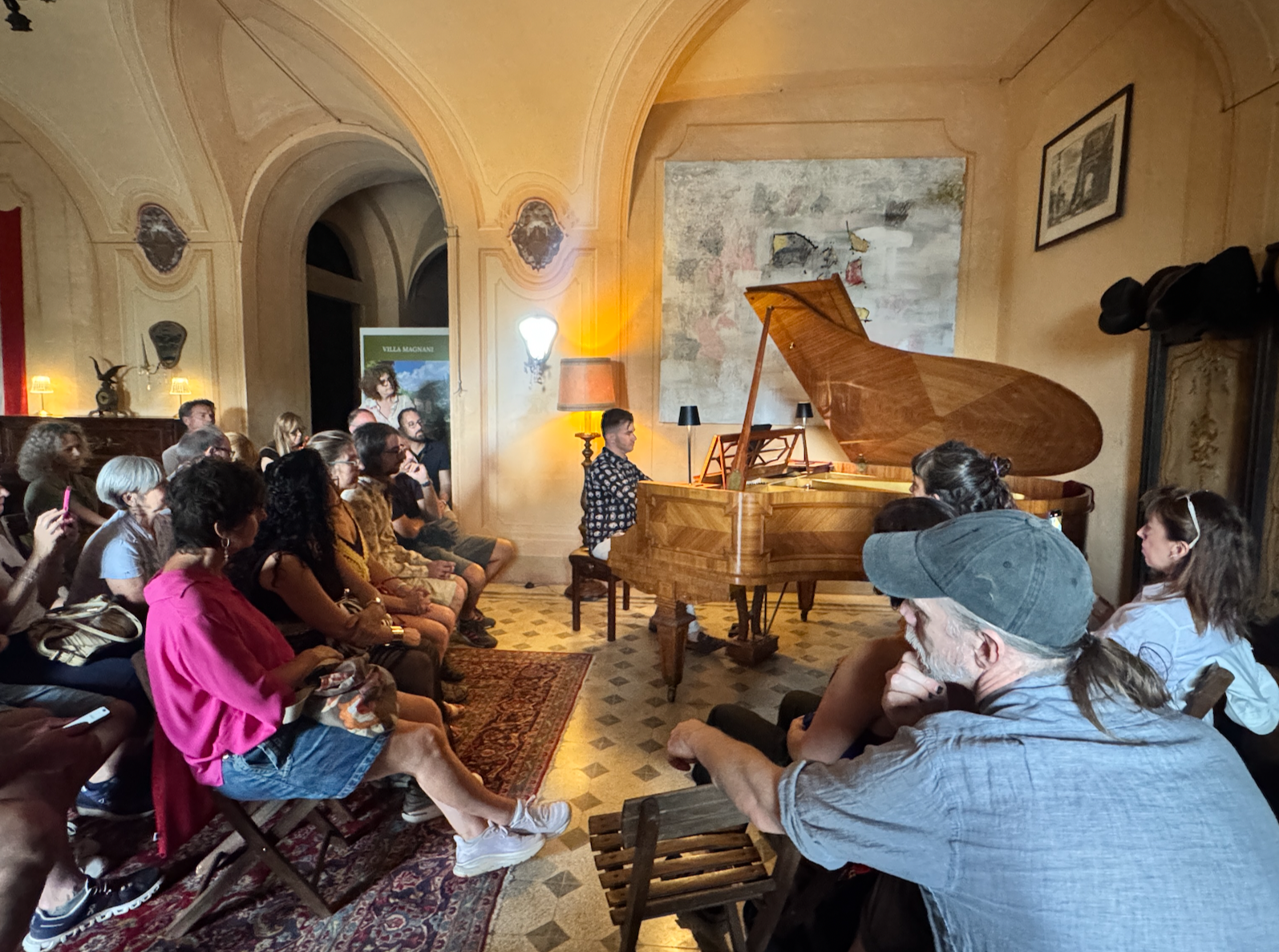
Dr Anthony Cardella at Villa Magnani
Site-Specific Piano Recital | Valle Cervo, Italy | July 25, 2026
Villa Magnani has long been a place where architecture, landscape, and cultural history exist in quiet harmony. Surrounded by the forests and mountains of Valle Cervo, the villa carries with it the accumulated memory of generations through its gardens, interiors, collections, and one of its historic pianos. On a warm afternoon in July, music became part of that continuing history as concert pianist and composer Dr. Anthony Cardella presented a recital that revealed not only the expressive breadth of the Ballade, but also the remarkable relationship that can exist between repertoire and place.
This was never intended to be a conventional piano recital. From the outset, it became evident that Cardella approaches programming with the same care that he brings to performance. Rather than assembling a sequence of celebrated works, he constructed a musical journey that invited listeners to move across centuries while remaining deeply connected to the atmosphere of Villa Magnani. The afternoon unfolded as a carefully considered conversation between Romanticism, twentieth-century modernism, contemporary composition, and music drawn from the villa’s own archive. Every work seemed chosen not only for its individual significance but for the dialogue it established with those around it.
Thoughtful programming is itself an artistic discipline. It requires an understanding of how compositions speak to one another, how they shape an audience’s experience over time, and how music may resonate within a particular environment. At Villa Magnani, Cardella demonstrated an uncommon sensitivity to these relationships. The result was a recital that felt unified from beginning to end, allowing the audience to experience the evolution of musical language while remaining continually aware of the place in which it was heard.
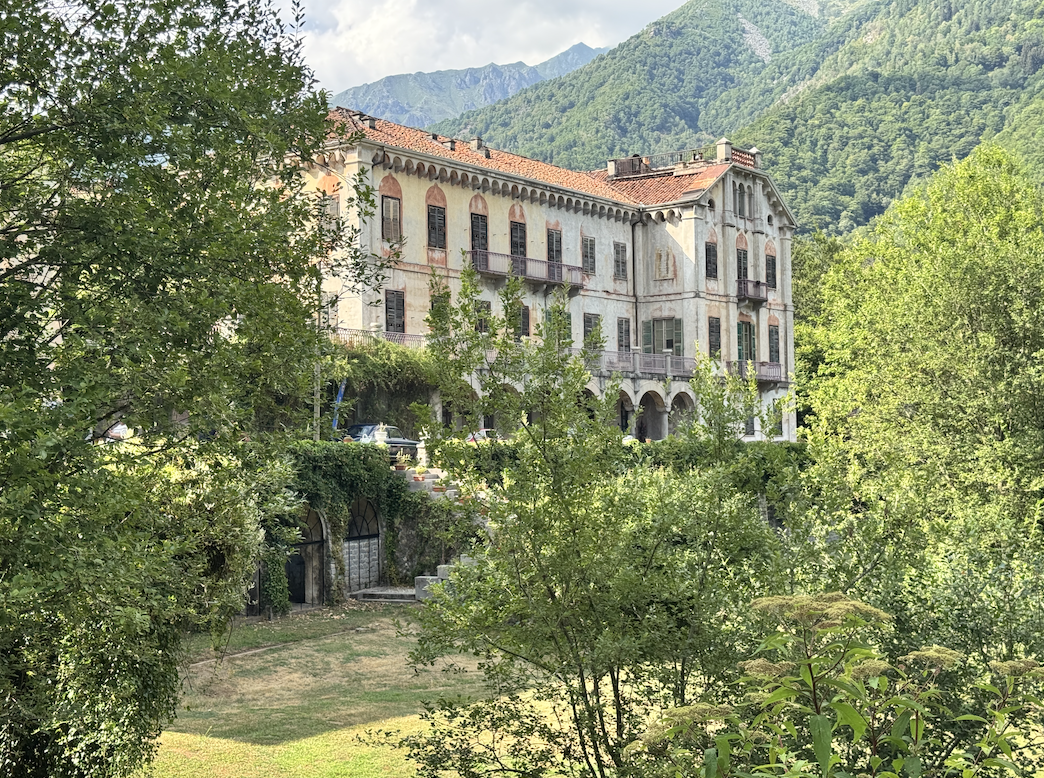
VillA Magnani, valley cervo, northern italy
The afternoon opened with Frédéric Chopin’s Ballade No. 1 in G Minor, Op. 23. Cardella resisted theatrical gesture, allowing the music to emerge with natural restraint and expressive clarity. His interpretation immediately established an atmosphere of attentive listening. As the Ballade unfolded, the audience became increasingly aware of the changing afternoon light filtering through the villa, the warmth of its historic interiors, and the stillness of the surrounding landscape. Rather than overwhelming the architecture with sound, the performance entered into a natural dialogue with it. One sensed that the villa itself had become part of the recital, not as a backdrop but as an active presence shaping the experience of listening.
Without disrupting this contemplative atmosphere, Cardella moved seamlessly into Judd Greenstein’s First Ballade. The transition was both surprising and entirely convincing. Where Chopin invited reflection, Greenstein opened the imagination. Bright harmonic colors, shifting rhythmic patterns, and a contemporary musical language introduced new energy while preserving the coherence of the afternoon. The work never appeared as a contrast for its own sake. Instead, it demonstrated that contemporary composition remains part of an ongoing artistic tradition, capable of conversing naturally with the music that preceded it.
Returning to Chopin with Ballade No. 2 in F Major, Op. 38, Cardella broadened the emotional landscape of the recital. Rich in contrast and dramatic transformation, the work revealed Chopin’s extraordinary ability to shape narrative through purely musical means. Cardella balanced lyricism and intensity with remarkable control, allowing each transition to unfold organically. The performance reflected not only technical mastery but a profound understanding of the architecture of the work itself.
A dramatic shift followed with Samuel Barber’s Ballade, Op. 46. Charged with electricity, urgency, and expressive force, Barber’s language expanded the emotional spectrum of the afternoon. Cardella embraced its complexity with confidence and precision while preserving the clarity of its structure. The performance reminded listeners that twentieth-century music possesses a vitality capable of standing naturally beside the great Romantic repertoire, enriching rather than interrupting the larger narrative of the program.
With Chopin’s Ballade No. 3 in A-flat Major, Op. 47, the recital gently returned to an atmosphere of lyricism and elegance. Surrounded by paintings, antique furnishings, decorative wallpaper, and objects that speak to the villa’s long cultural history, the music seemed entirely at home within its surroundings. The relationship between architecture and sound became increasingly apparent, not because the music illustrated the building, but because both shared a similar sense of refinement, proportion, and expressive balance.
One of the afternoon’s most memorable moments came with the inclusion of two Mazurkas by Mario Ferrari, selected from Villa Magnani’s own musical archive. Their presence transformed the recital into something deeply rooted in place. Performed on one of the villa’s historic pianos, these graceful dances briefly dissolved the distance between past and present. It required little imagination to picture another century in which such music might have accompanied evenings of conversation, celebration, and dancing through the villa’s elegant salons. For a few moments, Villa Magnani ceased to feel like a preserved historic residence and instead became what it once had been: a living cultural home animated once again by music.
The emotional and architectural arc of the afternoon reached its culmination with Frédéric Chopin’s Ballade No. 4 in F Minor, Op. 52. Universally regarded as one of the composer’s greatest achievements, the work gathered together many of the expressive qualities explored throughout the recital—lyricism and drama, intimacy and grandeur, reflection and resolution. Cardella’s interpretation unfolded with remarkable assurance, revealing not only technical command but a deep understanding of the Ballade’s extraordinary narrative structure. Every phrase seemed to grow naturally from the one before it, allowing the work to breathe with clarity, patience, and emotional honesty.
The audience responded warmly, inviting Cardella back to the piano for an encore. He concluded the afternoon with his collaborate composition with artist shane guffogg, Words Move, Music Moves, presented for the first time at Villa Magnani. Although the work has previously been performed in both Los Angeles and Italy, its presence within this historic setting assumed a distinct character. Rather than departing from the afternoon’s repertoire, it completed it. Having travelled through nearly two centuries of musical thought, listeners found themselves returned gently to the present, where contemporary composition stood not in opposition to tradition but in conversation with it.
The work unfolded with optimism, subtle color, reflection, and rhythmic vitality, inviting listeners to experience melody, harmony, gesture, and silence as interconnected forms of expression. Intellectual without becoming remote, and contemporary without abandoning its historical lineage, the composition affirmed that today’s music continues to grow from the same enduring artistic questions that have occupied composers for generations.
What distinguished the afternoon, however, was not only the quality of the performances but the thoughtful inquiry that preceded them.
For Cardella, preparation begins long before he sits at the piano. His study extends well beyond the technical demands of the score to embrace the broader cultural world from which each composition emerged. History, literature, poetry, visual art, and the life of the composer all contribute to a deeper understanding of the music. This inquiry does not seek to reinterpret a work or impose an external narrative upon it. Rather, it reflects a profound respect for the composer’s voice, allowing each score to be approached with historical sensitivity, intellectual curiosity, and artistic empathy.
The same thoughtfulness informs his programming. Cardella does not assemble repertoire simply because individual works are celebrated or technically rewarding. He considers how compositions speak to one another, how they shape an audience’s experience over time, and how they may resonate within a particular setting. Whether the dialogue is one of continuity or contrast, each selection contributes to a larger artistic idea. At Villa Magnani, this careful consideration allowed the recital to feel less like a sequence of performances than a single unfolding experience.
What distinguishes Anthony Cardella as a performer is his artistic assurance. Having devoted a lifetime to the piano, he performs with complete command of the instrument while remaining deeply attentive to the composer’s voice. His technical mastery never becomes an end in itself. Rather, it gives him the freedom to shape each work with sensitivity, intelligence, and conviction.
His stage presence is expressive without becoming theatrical. Every phrase is considered, every gesture purposeful. He never seeks to draw attention away from the music, nor does he place himself between the audience and the composer’s intentions.
Instead, he surrenders to the music.
That surrender should never be mistaken for restraint born of hesitation. It is the assurance of an artist who trusts both the score and the years of disciplined preparation that precede every performance. It reflects a musician secure enough in his craft to allow the music to speak with its own authority.
Throughout the afternoon at Villa Magnani, Cardella became less a soloist performing before an audience than a thoughtful guide leading listeners through an evolving conversation between Chopin, Greenstein, Barber, Mario Ferrari, and his own contemporary voice. Each composition illuminated the next, revealing unexpected relationships across time while preserving the individuality of every work.
The recital also demonstrated that programming is itself a form of artistic interpretation. Without altering the integrity of a single composition, Cardella revealed how carefully chosen repertoire can deepen our understanding of both music and place. The historic piano, the architecture of the villa, the surrounding landscape, and the accumulated memory of the estate became quiet collaborators in the experience, not because the music depended upon them, but because attentive programming allowed each element to enrich the others.
More than a piano recital, this was an encounter with the enduring relationship between music, history, and place. By the final note, listeners had experienced something increasingly rare: a performance in which repertoire, performer, instrument, and setting became inseparable. The afternoon affirmed that the finest concerts do more than present great music. They invite us to listen more deeply—to history, to architecture, to landscape, and ultimately to the humanity that continues to resonate through every enduring work of art.
Victoria Chapman
August 5, 2026
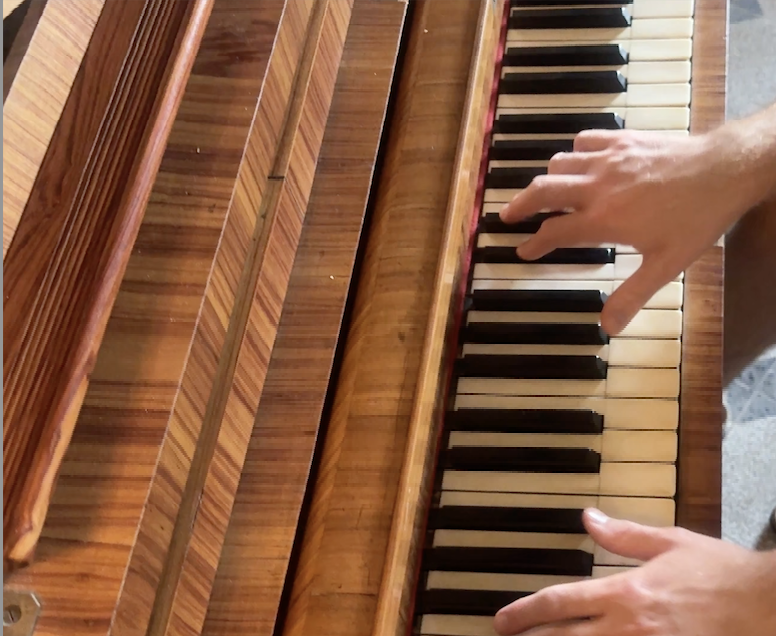
Dr anthony cardella at villa magnani, italy