The Artist and the Rural
Written by Victoria chapman
There is a necessity, at times, for the artist to leave.
Not necessarily to leave the city for the country, nor to escape one kind of life in favor of another, but to remove oneself from the familiar structures through which daily life has become organized.
An artist may live in a city, a suburb, a village, or already within a rural landscape. Geography is not entirely the point. What matters is a sense of change: interrupting the familiar routes, responsibilities, schedules, domestic rituals and patterns through which we unconsciously organize ourselves.
To go elsewhere is to wake where the light enters differently, to walk without following the usual path, to experience unfamiliar weather, vegetation, sounds, darkness, food, water and even silence.
The rural offers particular conditions for this shift because so much of what happens there exists independently of us. Water moves, plants grow and decay, weather arrives, light changes, animals pass through, darkness comes.
The artist is no longer at the center of these events.
Perhaps this sense of change is important.
Within our daily environments, artistic practice can become entangled with the structures surrounding it. We enter the studio at a certain hour. We move through familiar rooms and encounter familiar objects. We respond to messages, obligations, appointments, relationships and the accumulated evidence of our own lives.
Even the studio—the place we have created in order to be free—can eventually become another structure.
There are habits within artistic practice just as there are habits within daily life. The hand remembers. The eye remembers. The body remembers. We know which materials we reach for, how we begin, where we sit and what we avoid.
Without intending it, inquiry can become surrounded by predictable patterns.
To leave one’s familiar environment interrupts this.
When the usual signs are absent—when there is no established studio, no habitual route, no accumulated materials waiting to suggest what should happen next—the artist may encounter the inquiry differently. Perhaps we approach the practice in a less mediated state. Not pure in the sense of being emptied of history, but less conditioned by the immediate patterns of ordinary life.
The question can become visible again.
What am I actually looking for? What am I trying to understand? What happens if I don’t know what comes next?
My own recent experience taught me, however, that change does not necessarily result in greater productivity.
I removed myself from my familiar environment and spent an extended period within a rural place, yet I found that I was not able to make very much work. I made some tracings. I wrote. I looked.
Increasingly, I found myself doing something much more elementary.
I sat in rooms. I lay on floors. I looked.
And I stayed there.
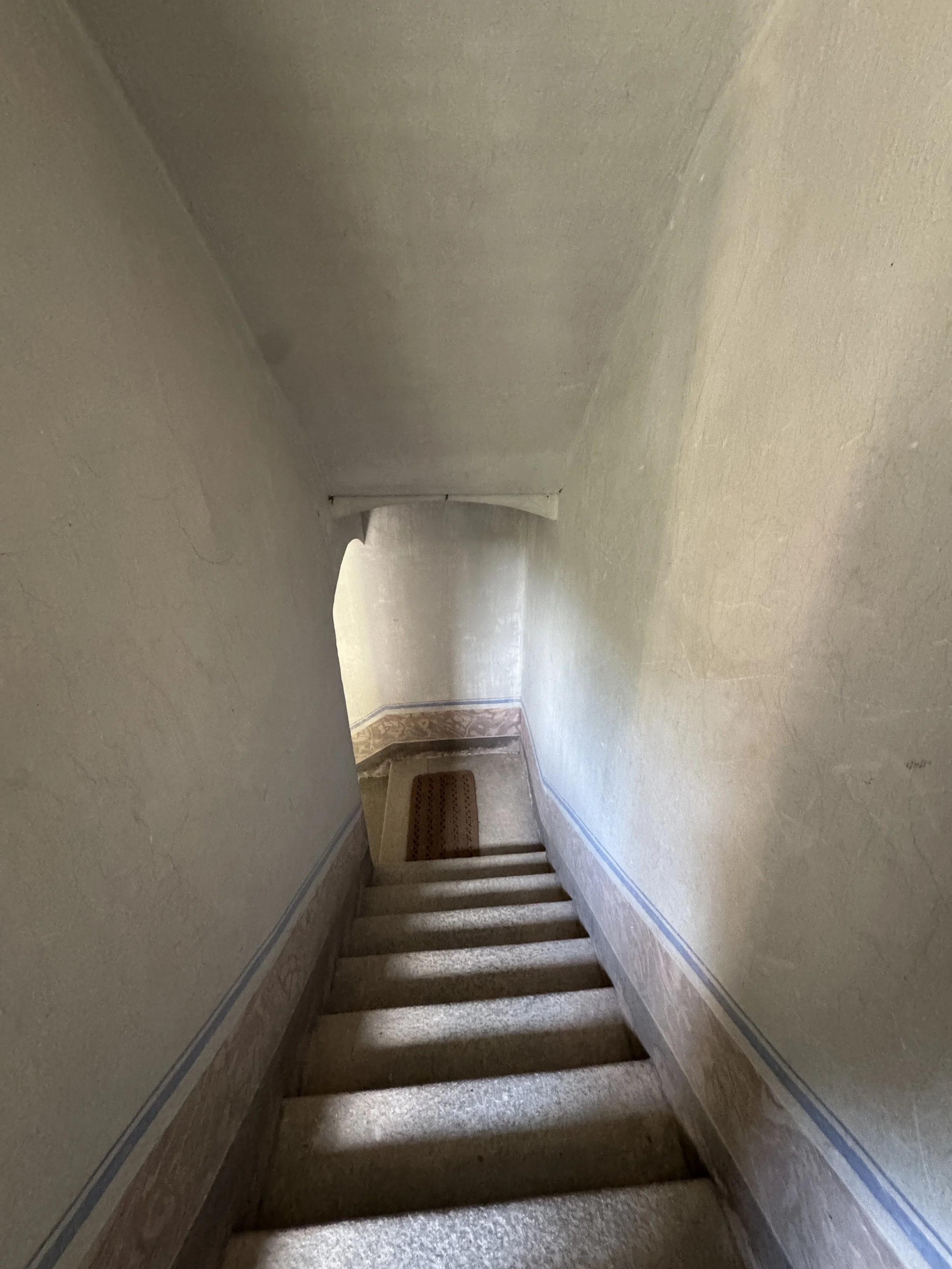
I began thinking about John Ruskin’s The Seven Lamps of Architecture and paying close attention to the materials surrounding me: granite, marble, wood, stained glass, floorboards, panels and ceilings. I studied windows and shutters, staircases and thresholds, how one material met another, how things had been constructed, and how light entered through an opening and moved across a surface. And how all these materials might have arrived at this place. Day after day, within each room, I sat on various chairs, on steps, leaned against walls, and lay on the floor in wonderment.
The building stopped being a setting and became something I was experiencing through my body.
I became interested in the threshold between a place and the person occupying it. There was the structure surrounding me and there was the structure of my own body.
The room was a vessel.
I was a vessel within it.
Beyond the room was the landscape.
Lying on the floor, I became increasingly aware of my physical presence—my breathing, the hardness beneath my body, the air of the room, my discomfort, vulnerability and fear. Without the ordinary structures through which I organized myself, I became more exposed to myself.
Thoughts and unresolved experiences that had been easier to push aside within the movement of daily life became increasingly difficult to avoid.
There was the room.
And there was me lying on its floor.
This is where I began to understand that leaving a space for another should not be romanticized as a return to peace.
When the noise surrounding us diminishes, another kind of noise may become audible.
At times I became overwhelmed and needed to leave the building and walk. The landscape became important then in a way I had not anticipated.
I wasn’t walking through nature looking for artistic material. I wasn’t trying to photograph it or determine what it meant. I needed its physical presence: the ground beneath my feet, trees, moving water, moss, cool air and rain against my skin.
The rain became a gentle reminder of a world continuing outside the intensity of my own thoughts.
Nature was not providing inspiration.
It was providing scale.
The tree did not need anything from me. The water did not require an explanation. The rain did not ask me to make something from it.
Perhaps, for a time, I did not need to ask anything from myself either.
I had assumed, perhaps without recognizing the assumption, that removing myself from ordinary life would create greater space for artistic practice.
Instead, it created greater space for being.
And being was considerably more difficult.
I was running away from the building to find a sense of calm. It wasn’t the building, it wasn’t the room, it wasn’t the people in the space. It was the volume and intensity of my being on a cellular level. I was running away from something. But what was it?
I came to a rural place hoping to find peace. But the thing blaring in my mind was so loud that I had to run to another refuge. I returned to long walks among the trees. The limbs of the trees seemed to caress my thoughts, and my legs and feet felt connected to the earth as I walked. The motion guided me forward, toward a kinder existence, away from the blaring structure within myself.
Later, I returned to the building and all its nature. I lay back down on the floor. I looked at the ceiling, following the lines as they passed through shapes and met colors and textures. I remembered being a child, and how this sense of discovery while lying on the floor had once been an everyday practice. Imagining life and rooms upside down.
I found peace and calm in this.
The next day I returned to sitting in each room on various structures, asking nothing, just following lines. Acknowledging textures. Finding lightness and darkness within the architectural structures. Just being in the space and looking. Not analyzing or coming to any conclusions. Just existing.
There should be places within an artistic life where nothing is being asked of the practice: to walk without photographing, to sit without writing, to observe without documenting, to touch the earth without turning the experience into material.
These experiences return attention to the body, and the body returns us to the self: to realization, or the unknown.
Before deadlines, projects and exhibitions, before the expectations we place upon ourselves and those placed upon us by others, we inhabit a body. We are flesh, breath, temperature and sensation.
To become conscious of this again, is to return to the essence of being.
The escape into the rural should not become another instrument we use to make ourselves more productive. A retreat should not become another studio with a prettier view. Otherwise, we have simply transported the structures we were attempting to interrupt.
There must remain the possibility of doing nothing—and, perhaps more importantly, allowing an experience to remain an experience.
Artists are accustomed to taking things from the world. We photograph, record, collect, write, interpret, archive and transform. Experience quickly becomes material.
But what happens if occasionally nothing is collected?
What if an encounter does not immediately become an artwork?
My experience taught me something about looking.
Looking does not always have to be preparation for making.
Looking can be enough.
To study the grain of wood, the weight of stone, the irregularity of an old floorboard, the construction of a staircase or the movement of light across a wall—these experiences do not need to become drawings or photographs to have value.
Perhaps this is something we lose when artistic practice becomes too closely associated with production.
Before something is made, there is looking. Before looking, there is attention. And before attention, perhaps there must sometimes be enough emptiness for us to notice where we are.
That emptiness can also expose vulnerability. Without the familiar structures of daily life, discomfort, fear, tenderness, exhaustion, pleasure and uncertainty may become more present. We become aware of our boundaries and of what allows us to feel safe.
This is not necessarily a failure of retreat.
It may be part of its necessity.
The rural does not promise healing, and nature is not always a remedy. What surfaces may not be resolved.
But something can be acknowledged.
Perhaps acknowledgment is enough.
When we eventually return to artistic practice, the effect of the experience may be difficult to measure. The hand may become more fluid. A decision may become less forced. We may become more willing to tolerate uncertainty, accident or change.
Or nothing immediately visible may happen at all.
Its significance may emerge much later—in an image, a sentence, a relationship with a material, the abandonment of an old habit, or simply in a changed understanding of what is necessary and what is not.
Sometimes being on a retreat is a leap into another realm.
And the takeaway may be to experience a room differently.
I began by looking at architecture: the materials of a building, its surfaces, openings, thresholds and structures.
Eventually I realized I was considering another architecture as well.
The architecture of myself.
What had been constructed. What had been protected. What had been closed. What could be opened. And what I was finally willing to enter.
The artist in the rural, then, is not primarily a question of where art gets made. It is a question of what can happen when the artist steps outside the environment that continually confirms who they are and how they work.
To become unfamiliar for a while.
To encounter the body again.
To look and listen.
To allow vulnerability.
And eventually, to return.
Not necessarily healed. Not necessarily resolved. Not necessarily with something to show.
But perhaps able to approach the inquiry with less surrounding it.
We often go into nature believing we are going there to find peace. Sometimes what we find first is everything that has been preventing us from feeling it.
The rural does not need to provide the answer.
Perhaps it allows us to hear ourselves again?
V. C. los angeles - valley cervo - los angeles, August 18, 2026