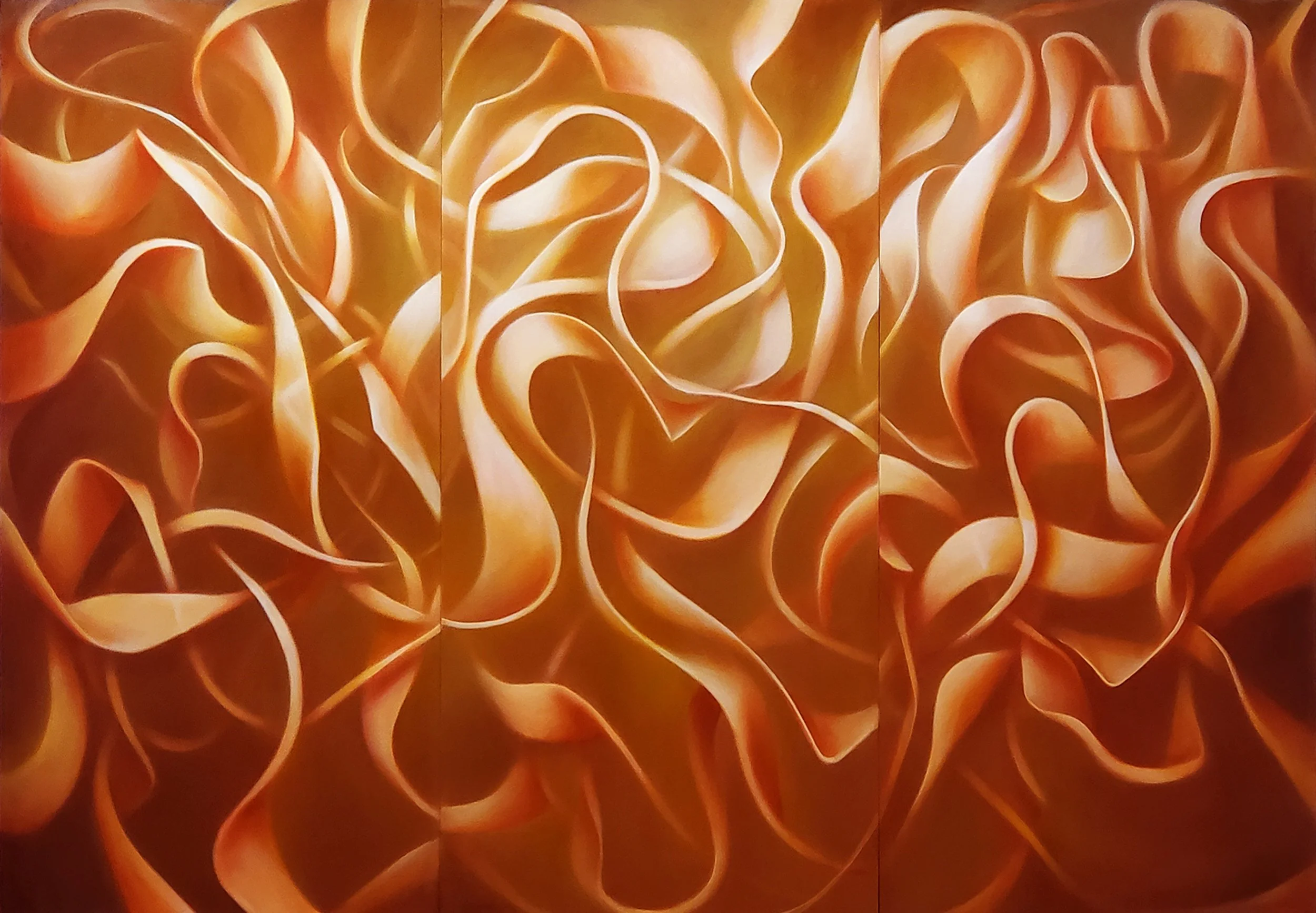
Shane Guffogg, "The Evolution of the Mortal Soul/ Past. Present and Future"
80"x 117.25"
(triptych each panel 80" x 39") Oil on canvas
(203.2 cm x 297.18 cm)
2018 - 2019
the first and last language
an introduction to the paintings of shane guffogg
written by victoria chapman
For as long as humanity has left a record of its existence, it has made images. Across time and cultures, these images have remained enduring forms of human communication. Although their purposes have varied—and many may never be fully understood—they remind us that not every form of communication depends upon words. It is in this sense that art may be considered humanity’s first and last language.
To speak of language is to speak of far more than words. We are shaped by light before we describe it and by sound before we interpret it. Color, movement, gesture, and silence inform human experience in ways that cannot always be translated into speech. Before we understand the world through language, we first encounter it through perception. Painting belongs to this broader field of experience, inviting us to perceive before we explain.
Throughout history, artists have sought to give form to that which cannot be fully described. For Shane Guffogg, painting is as necessary as breathing. Through years of contemplative practice, he has developed a way of working that begins by quieting the analytical mind, allowing him to become receptive to what he has described as the unbounded. Rather than directing the work toward a predetermined outcome, he permits the painting to unfold through him.
Guided by intuition and the movement of his entire body, Guffogg patiently builds each painting through the accumulation of thousands of delicate brushstrokes. Whether composed of richly saturated color or restrained, earthy tones, each canvas gradually discovers its own visual language through successive layers of oil paint. Working within the glazing tradition established by the Old Masters, he applies translucent veils that allow light to emerge from within the painting rather than simply fall upon its surface. His compositions frequently employ multiple sources of illumination, recalling painters such as Rembrandt while transforming these historical methods into a distinctly contemporary visual language. Whatever the palette, each painting evolves through a slow process in which color, transparency, and light reveal themselves over time. The work is not so much constructed as discovered.
When these works leave the studio, that dialogue continues. They do not ask to be solved or interpreted as fixed meanings. They invite encounter. Many viewers find themselves unexpectedly moved—not because they understand the paintings intellectually, but because the paintings awaken forms of perception that lie beneath ordinary language. They awaken memory, sensation, emotion, and those quieter dimensions of experience that resist explanation. In this way, the paintings remind us that perception is richer than thought alone, and that understanding may arise through experience before it arrives in words.
The essays that follow approach Guffogg’s work from two complementary perspectives. One considers the relationship between his contemplative practice and the life of the soul. The other explores synesthesia and the experiential qualities of perception, asking how light, color, sound, and the act of seeing may converge in our encounter with painting. Together, they offer two ways of approaching a body of work that continues to invite reflection rather than conclusion.
If art may be considered humanity’s first and last language, it is not because it replaces words, but because it reminds us that not every human experience can be contained by them. In every age, painting offers another way of encountering ourselves and the world around us, where the mystery of being human is first experienced, and only later spoken.
V.C.
6/30/2026